Showing posts with label strategic analysis. Show all posts

Monday, January 18, 2010

Another Sign That America's Strategic Position In The World Is Changing

U.S. Keeps Science Lead, But Other Countries Gain -- Wall Street Journal

The U.S. remains the world's science and technology leader, but other countries are gaining ground, the National Science Board said Friday in its biennial report on science and engineering.

The U.S. accounted for nearly a third of $1.1 trillion spent on research and development globally in 2007, minted more science and engineering doctorates than any other country, and led the world in innovative activity. Efforts by China and other developing Asian countries to boost their science and engineering capabilities are bearing fruit, however, and the gap between them and the U.S., though still wide, is narrowing.

Read more ....

More News On America's Declining Role In Science

Worrisome Trends Show Eroding U.S. Competitive Advantage in World Science and Engineering Environment
-- Science Daily
New Science "Indicators" Data From NSF Captures China's Rise -- Science Insider
Asia Ascending in Science and Engineering -- Physorg
U.S. Scientific Inventory Shows Asia, EU Gaining in R&D Status -- BioWorld
Is America competing? -- The Scientist

Saturday, January 9, 2010

Outside View: Strategic Incompetence -- The Greater Threat?

President Obama in the Oval Office. Pete Souza/The White House

From UPI:

WASHINGTON, Jan. 6 (UPI) -- To most Americans, with deference to climate change and Iran, the major national security threat to the nation emanates from al-Qaida. Yet strategic incompetence on our part may be a greater danger. This characteristic is not new.

During World War II Winston Churchill and his generals frequently complained about the inability of America to think strategically, relying instead on nearly unlimited resources to deliver the tools that ultimately won the war. Some two decades later as the Vietnam War raged, Harvard Professor Stanley Hoffmann wistfully observed that America believed that its adversaries either reasoned strategically as we did or were in desperate need of being educated to our level. When America overwhelmed the Taliban in Afghanistan and then overthrew Saddam Hussein's Iraq, the aim was to change the geostrategic landscape of the greater Middle East.

Read more ....

My Comment: There is a lot to digest in the above analysis .... and there is much that I do agree with. If I was to add to the discussion, I would stress the point that many of our leaders and their advisers do understand the strategic view .... but are hindered by their own constituencies and special interests. The media, economic interests, the interests of our allies, political opponents with their own political agenda .... all of these factors come into play.

As a democracy we are limited in our actions, and while many may say this hinders our strategic views and options .... I say that it is our strength. If we make a mistake .... we are always quick to change the strategy. If sacrifice is necessary ... we are always willing to sacrifice if the cause is just and the strategy is presented as such. What is important is that as long as our differing viewpoints and opinions are respected .... we will always persevere .... even when our strategic views and options are hindered and/or even flat wrong. And in the end .... that is what counts.

Wednesday, January 6, 2010

The Issues That Will Shape The World In 2010


From Der Spiegel:

The past year seemed a fitting end to a decade during which the world lurched from crisis to crisis. The list of unfinished business is long and many pressing issues are set to demand attention in 2010. SPIEGEL presents the ones to watch.

The year 2009 seems to have left behind more unfinished business than accomplishments. Topping the list, of course, were climate talks in Copenhagen, which left behind little more than a vague roadmap for a possible way forward as the world searches for a joint strategy to combat global warming.

Read more ....

My Comment: I would also add the ongoing wars in Afghanistan and Pakistan to this list.

Thursday, September 3, 2009

Straining Hard To Find A Peer Threat

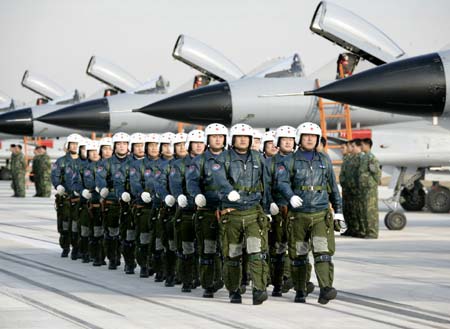
Chinese air force pilots walk in front of J-10 fighter planes at a military base December 18, 2006. The air force has been equipped with the new generation of Jian-10 fighter, independently designed by China. The fighter is capable of launching "precision attacks while hedgehopping and making long-distance assaults at altitude above 10,000 metres." [Xinhua]

From New Wars:

Some in the Media will go to great links to justify continuing Cold War building policies, while our troops fight new wars in Afghanistan and elsewhere. For instance, the Wall Street Journal here is trying to “talk up” the threat posed by new and planned Chinese fighters:

China’s fifth-generation efforts date back to the early 1990s and will start with two heavy fighters from China’s two main fighter companies. A Chinese source told me in early 2005 that the Chengdu Aircraft Corporation, famous for developing the fourth-generation J-10 fighter, was considering the development of a medium-weight fifth-generation plane comparable to the F-35. This could mean that Chengdu’s fighter will be built in vertical take-off and aircraft carrier versions. In 2006, the competing Shenyang Aircraft Corporation revealed a concept for a single-engine forward-swept-wing fighter that would be highly maneuverable and potentially stealthy. It seems the PLA envisions two levels to its program: a heavy fighter for maintaining air superiority, and a medium-weight plane that’s cheaper and more versatile.

Read more ....

My Comment: Kudos to New wars ..... I could not have said it any better.