Showing posts with label space program. Show all posts

Thursday, August 30, 2012

How One U.S. Navy Captain Used A Creative Way To Provide For His Family If He Died


Neil Armstrong Couldn't Afford Life Insurance, So He Used A Creative Way To Provide For His Family If He Died -- Business Insider

After all the danger, glory, and fame it's easy to forget that at the end of the day astronauts are federal employees subject to the same General Schedule (GS) pay scale as everyone from typists to CIA agents.

Unfortunately, a federal salary wasn't enough for Apollo 11 astronauts to purchase life insurance.

Read more
....

My Comment: A small confession .... as a stamp collector, I would pay $5,000 for such a signed postcard.

Wednesday, September 21, 2011

America's Dominance In Space To Continue


Secret Sats, Giant Rockets: U.S. Unveils Space War Arsenal -- Danger Room

When the Space Shuttle flew its 135th and final mission in July and retired without a direct replacement, some critics accused Washington of abandoning America’s 50-year orbital legacy. The Telegraph even called it a “retreat.”

Then last week, the U.S. government revealed new and formerly secret space initiatives that underscore America’s continuing orbital dominance. NASA announced plans for the biggest-ever rocket, set to launch in six years. Meanwhile, the hush-hush National Reconnaissance Office (NRO), keeper of America’s most secretive surveillance satellites, used the occasion of its 50th birthday to declassify its ongoing orbital eavesdropping campaign over Afghanistan.

Read more ....

My Comment:
The big question is .... will Congress release the funds for this program to continue. In an age of deep budget cuts and lack of money .... there is no guarantee that this will be the case.

Wednesday, July 27, 2011

Russia Plans To Pull The Plug On The International Space Station In 2020

The International Space Station and the docked space shuttle Endeavour, flying at an altitude of approximately 220 miles, seen from the Soyuz TMA-20 following its undocking on May 23, 2011 (USA time). It is the first-ever image of a space shuttle docked to the International Space Station.

Russia Plans to Sink the International Space Station in 2020 -- FOX News

Russia's space agency announced Wednesday that the International Space Station -- a space base the world's scientists and billions of U.S. tax dollars helped build and maintain some 200 miles above the surface of the Earth -- will be de-orbited and allowed to sink into the Pacific Ocean in 2020, just like its Russian predecessor, Mir.

"We will be forced to sink the ISS. We cannot leave it in orbit as it is a very complicated and a heavy object," Roscosmos' deputy head Vitaly Davydov said in an interview posted on the agency's website.

"We have agreed with our partners that the ISS would function roughly until 2020," he noted.

Read more ....

My Comment: I betcha no one saw that coming in Washington.

Thursday, July 21, 2011

Space Shuttle: The End Of An Era


Shuttle Retirement Ushers In New Era -- BBC

The cheers and the tears. The Atlantis shuttle returned from space on Thursday, book-ending the 135-flight sequence of Nasa's re-usable spaceplanes.


People will debate long and hard on the value of the shuttle. There's no denying its iconography; its story is inextricably linked with that of Hubble; and it gave us the space station.

And as Valerie Neal, the space history curator at the Smithsonian National Air and Space Museum, points out in her assessment article for the BBC, the shuttle made possible "our continual, expanding presence in space".

Read more ....

My Comment: The end of America's shuttle program/space program .... and this is essence what it has become .... is a sad day for America and for those who have followed NASA (myself included) since the beginning.

Thursday, February 3, 2011

Future U.S. Space Strategy Will Have A Military Focus

Military Focus Seen in Future U.S. Space Strategy -- CBS News

The official strategy for protecting the nation's space assets, due to be released soon, will probably focus on security from a primarily military perspective, experts say.

The Obama administration is expected to announce its National Security Space Strategy in the next week or so. The NSSS spells out how the Department of Defense and the Office of the Director of National Intelligence will carry out the country's National Space Policy, which the president issued last June.

Read more ....

My Comment: The space program since it's inception has always had a military aspect to it .... the Obama administration is just eliminating any pretense that it is not.

Thursday, September 30, 2010

U.S. Military Space Programs Are At Risk

Photo: Retired Air Force Lt. Gen. Henry (Trey) Obering. (Radio Free Europe)

Military Space Programs at Risk, Experts Say -- Global Security Newswire

WASHINGTON -- U.S. national security space capabilities, so critical to deployed combat forces and national missile defense, and the supporting industrial base are at a dangerous "tipping point" and need focused leadership and long-term stability in programs and budgets to avoid a crisis, a panel of administration officials and defense space experts warned yesterday (see GSN, July 27).

Retired Air Force Lt. Gen. Henry (Trey) Obering, the former director of the Missile Defense Agency, warned that the soaring cost and prolonged development time for new satellites had left the nation with no backup systems to replace any that could be affected by hostile action.

Read more
....

Update: Military space programs at risk, experts say -- Government Executive

My Comment: This is not the only program that is at risk. But with Congress now facing unsustainable budget deficits, space programs like NASA and the U.S. military space program are at real risk of suffering severe budget cutbacks.

Tuesday, June 29, 2010

A New Arms Control Treaty Limiting The Development Of Space Weapons?

Obama Reverses Bush’s Space Policy -- New York Times

The Obama administration on Monday unveiled a space policy that renounces the unilateral stance of the Bush administration and instead emphasizes international cooperation, including the possibility of an arms control treaty that would limit the development of space weapons.

In recent years, both China and the United States have destroyed satellites in orbit, raising fears about the start of a costly arms race that might ultimately hurt the United States because it dominates the military use of space. China smashed a satellite in January 2007, and the United States did so in February 2008.

Read more ....

More News On President Obama's Space Policy

Obama Backs Away from Intergalactic Domination -- The Danger Room
Obama calls for international cooperation in space -- L.A. Times
W.H. releases National Space Policy -- Politico
White House Unveils Space-Policy Goals -- Wall Street Journal
Obama lays out new US space policy -- AFP
Obama seeks international cooperation in space -- AP
Obama space policy prizes international cooperation -- Christian Science Monitor

Monday, April 26, 2010

Is The U.S. Experiencing A Rocket Motor Shortage, And Will It Impact National Security?


U.S. Spy Satellite Program Could Be Undermined By Flagging Demand For Rocket Motors -- Lexington Institute

Amy Butler of Aviation Week & Space Technology reported last week that the super-secret National Reconnaissance Office will be launching new spy satellites over the next two years at the highest rate since the Reagan era. Butler quotes NRO director Bruce Carlson as stating that several "very large, very critical" spacecraft will be sent into orbit by his agency -- presumably systems that collect imagery of surface targets or eavesdrop on the radio-frequency transmissions of potential adversaries. Combined with impending launches of new military-communications and missile-warning satellites, news of the spy-satellite payloads will come as welcome news to the nation's endangered rocket-motor industry.

Read more ....

Hat Tip:
Defense Industry Daily

My Comment: Someone has taken the eye off the ball on this one.

Monday, September 7, 2009

Is The Near-Earth Space Frontier Closed?

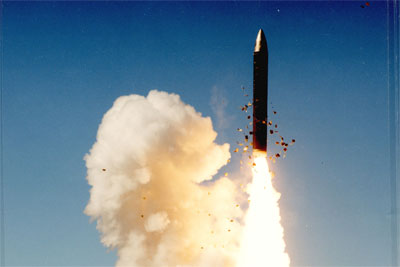
The development of the ICBM, and the satellite systems linked to these missiles, created a synergistic relationship that effectively settled the near-Earth space frontier. (credit: US Air Force)

From Space Review:

How the ICBM opened, developed, and closed its own frontier.

If you challenged people in the civilian space community to identify a set of space systems that repaid their initial investment in proportion to their cost, most would be hard pressed to identify more than one or two nonmilitary systems. That set of applications would unlikely be a compelling enough reason to pour the resources that would be needed to open the space frontier from scratch.

Read more ....

My Comment: Not an easy article to read. I do understand the role that militarization of space has had on the space program, but the trend is now to the commercialization of space, via tourism, communications, GPS, and satellite imagery.