Showing posts with label robot war. Show all posts

Friday, May 3, 2013

UN Wants A Moratorium On 'Killer Robots'


'Killer Robots Should Not Have Power To Destroy Human Life': U.N. Report Warns Britain And U.S Have Semi-Autonomous Machines -- Daily Mail

* The report written for U.N. Human Rights Commission
* Experts call for worldwide moratorium on the use of killer robots
* Said Britain, the U.S., Israel, South Korea and Japan have developed various types of fully or semi-autonomous weapons

Killer robots that can attack targets without any human input 'should not have the power of life and death over human beings,' a new draft U.N. report says.

The report for the U.N. Human Rights Commission this week has called for a worldwide moratorium on the use of killer robots until an international conference can develop rules for their use.

According to the report, the United States, Britain, Israel, South Korea and Japan have developed various types of fully or semi-autonomous weapons.

Read more ....

More News ON The UN Calling For A Moratorium On 'Killer Robots'

UN Report Wants Moratorium on Killer Robots -- Time/AP
UN report wants to terminate killer robots -- Calgary Herald/AP
New UN Report Calls For The Cessation Of All Military Drone Fabrication -- Business Insider/Global Post
U.N. calls for moratorium on U.S., Israeli ‘killer robots’ -- Washington Times
UN Draft Report Recommends Ban On Killer Robots -- Huffington Post
No killer robots, says UN-- News24
Automated killer robot development should be paused, says UN report -- The Verge
Development Of Automated Killer Robots Should Be Suspended: UN -- Digital Times

WNU Editor: The UN draft report is here.

Sunday, April 14, 2013

The Rise Of Robot Wars

Terror threat: Drones could fall into the hands of terrorists Schmidt warns

The Rise Of Robot Wars: Google Chief Warns Armed Drones Will Soon Be In The Hands Of Terrorists And Miniature Models Could Be Used To Spy On Neighbors -- Daily Mail

The head of Google has warned drone technology proves a serious danger to global security and privacy unless an international treaty is put into place controlling the technology fast.

Eric Schmidt today said that the technology for armed unmanned planes will soon pass into the hands of terrorists posing huge security concerns across the globe.

He also said that ever expanding drone technology is making smaller and cheaper models, including nano-drones, which could be used by nosy neighbors spying on each other in a dispute.

Read more ....

My Comment: This blog has been saying the same thing for the past few years .... drones will become common and readily available .... until .... one of them is used in a bomb attack on the White House or at some major public event.

Maduro Narrowly Wins Venezuela Election


Nicolas Maduro Wins Venezuela Presidential Election -- Reuters

Socialist candidate Nicolas Maduro has won a narrow victory in Venezuela's presidential poll.

Mr Maduro, who was chosen by the late Hugo Chavez as his successor, won 50.7% of the vote against 49.1% for opposition candidate Henrique Capriles.

The electoral commission said the results were "irreversible".

Mr Capriles said he refused to accept the result without a recount, and said he believed that Mr Maduro had lost the election.

Earlier, Mr Capriles had suggested there was an attempt to doctor the result.

Read more ....

Update: Chavez ally Maduro narrowly wins Venezuela election -- Reuters

My Comment: They could only get 50.6% of the vote .... even though they controlled the electoral process. Here is an easy observation .... this result shows that a lot of Venezuelans are deeply dissatisfied.

Thursday, August 25, 2011

Say Hello To The New Military-Robotics Complex

A microdrone during a demo flight at Wright-Patterson Air Force Base. Chang W. Lee/The New York Times


Robots And The End Of War As We Know It -- Washington Post


Rapid advances in robotics technology, combined with the need for innovative new technologies to combat insurgents on the battlefields in Iraq and Afghanistan, are turning robots and unmanned drones into the next hot area of military innovation. The most sophisticated of the new military bots weigh less than five pounds. Then there are others that can fit into your pocket, and be connected via a mesh network. That network gives them the ability to coordinate activities, such as detonating improvised explosive devices (IEDs) or scouting out locations, in real-time as part of a robot swarm.


Not surprisingly, the U.S. Army is now seeking to deploy thousands of these tiny military bots.


Read more ....


My Comment: The ultimate goal .... I guess .... is to have this type of future (but with man in control of it).

Tuesday, August 2, 2011

Private Robot Armies

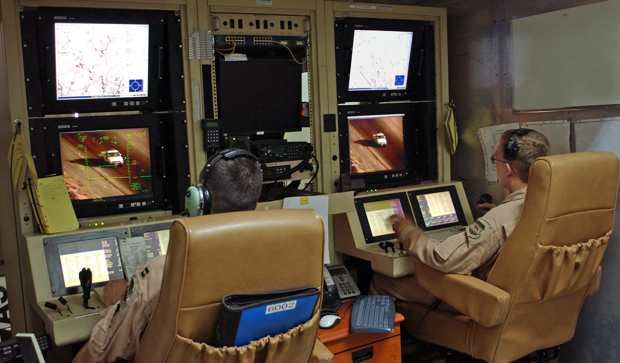
MQ-1 Predator controls. Wikipedia

The DIY Terminator: Private Robot Armies And The Algorithm-Run Future Of War -- Fast Company

In the latest installment of the Butterfly Effect: Predator drones are just the start of unmanned, autonomous warfare technology. But as the tech becomes more democratized and more deadly, what happens when anyone can assemble an army of killing machines?

1. Attack Of The Drones

Last month, NATO’s commanders in Libya went with caps-in-hand to the Pentagon to ask for reconnaissance help in the form of more Predator drones. “It’s getting more difficult to find stuff to blow up,” a senior NATO officer complained to The Los Angeles Times. The Libyan rebels’ envoy in Washington had already made a similar request. “We can't get rid of [Qaddafi] by throwing eggs at him,” the envoy told the newspaper.

Read more ....

My Comment: A thought provoking analysis on the growth and role of robot war machines.

Friday, January 14, 2011

Are Military Machinese Being Given Too Much Power?

Science Fiction? Nick Kaloterakis

The Terminator Scenario: Are We Giving Our Military Machines Too Much Power? -- Popular Science

Even as we imagine the day when robots finally turn against us, scientists are at work on how best to control them.

Last August, U.S. Navy operators on the ground lost all contact with a Fire Scout helicopter flying over Maryland. They had programmed the unmanned aerial vehicle to return to its launch point if ground communications failed, but instead the machine took off on a north-by-northwest route toward the nation’s capital. Over the next 30 minutes, military officials alerted the Federal Aviation Administration and North American Aerospace Defense Command and readied F-16 fighters to intercept the pilotless craft. Finally, with the Fire Scout just miles shy of the White House, the Navy regained control and commanded it to come home. “Renegade Unmanned Drone Wandered Skies Near Nation’s Capital,” warned one news headline in the following days. “UAV Resists Its Human Oppressors, Joyrides over Washington, D.C.,” declared another.

Read more ....

My Comment: It is a long article .... read it and enjoy.

Tuesday, November 30, 2010

Will Robot Soldiers Make Better Decisions On A Battle Field?


Swarms of Robot Soldiers Could Make Better Decisions Than Human Leaders on Data-Strewn Battlefields -- Popular Science

Modern warfare relies increasingly on robotics for intelligence gathering and increasingly for strike capabilities, but the decision-making capacity still rests solely in the hands of human commanders. But British defense company BAE systems is testing a way to turn over battlefield decisions over to robot troops as well.

Read more ....

My Comment: The programming for such hypothetical war robots will still be based on human judgment and guidelines. Still .... with the emotional component left out .... such soldiers will probably make better decision than human leaders, especially since they will be able to digest information and data much quicker than their human counterparts.

Friday, October 29, 2010

Say Hello To Northrop's Robot With One Big Gun

CaMEL Gun-Bot Wired

Northrop Shows Off A Touchscreen-Controlled Robot Wielding A Giant Machine Gun -- Popular Science

Even the Army seems scared of this one.

Northrop's heavy-duty hauler CaMEL has been a success, scoring contracts from Israel and serious interest from the U.S. Army. But why haul miscellaneous stuff when you can haul a giant gun instead?

The hauler is named the Carry-all Mechanized Equipment Landrover--yeah, that spells out CaMEL. It's a 60-inch-tall treaded vehicle capable of carrying an impressive 1,200 pounds of stuff, and its usefulness in the field is proven by its popularity. Israel has bought more than 60 of them, and the U.S. Army is looking into its possibilities as well.

Read more ....

My Comment: This picture caught my eye .... but is such a system practical? Hhmmm .... probably not.

Saturday, October 23, 2010

Are Robot Weapons About To Be Regulated By The U.N.?

A predator drone like those used in missions over Afghanistan and Iraq prepared to be shipped from a General Atomics plant in Poway, Calif., where it was built. Jim Wilson/The New York Times

U.N. Urged To Set Up Panel On Ethics Of Robot Weapons -- Reuters

(Reuters) - A U.N. investigator called on the world body on Friday to set up a panel to study the ethics and legality of unmanned military weapons -- an apparent reference to U.S. drones that strike suspected Islamist militants.

In a report to the U.N. General Assembly human rights committee, Christof Heyns said such systems raised "serious concerns that have been almost entirely unexamined by human rights or humanitarian actors."

Read more ....

My Comment: I have heard of some "up in the sky" ideas in my life .... but this is a real winner.

Thursday, June 17, 2010

Rules Of Engagement Will Soon Be Written As Software For Unmanned Drones

CREECH AFB, Nev. -- Ground crew watch as an MQ-9 Reaper moves out of its shelter at Creech AFB, Nev. June 25, 2008. Larger and more powerfull than the MQ-1B Predator, the Reaper can carry up to 3,750 pounds of laser-guided bombs and Hellfire missiles. The MQ-9 Reaper is assigned to the 42nd Attack Squadron, part of the 432d Wing and 432d Air Expeditionary Wing.(Photo by Steve Huckvale)

How Does a Terminator Know When to Not Terminate? -- Discover Magazine

In the skies above Afghanistan and along the roadsides of Iraq, unmanned military machines are changing the nature of combat. These robots may soon be making life-or-death decisions themselves.

On a scorching early afternoon in August 2007, Col. David “Diesel” Sullivan was doing his daily rounds at Creech Air Force Base outside Las Vegas when he got the call. A pilot under his command at the base, remotely flying an armed, unmanned MQ-9 Reaper aerial drone in eastern Afghanistan, had spotted four men perched on an Afghan hilltop. Were they Taliban? If so, they were perfectly placed to ambush an American raiding party just hours away.

Read more ....

My Comment: It appears that the goal is to take out the human element in making decisions based on what are the rules of engagement, and giving that responsibility to a software program.

I am not impressed .... this is all about positioning oneself to not be responsible and/or accountable for a mistake.

Saturday, June 5, 2010

UAVs 'Changing The Face Of Warfare'

MQ-9 Reaper And It's Pilot. Image from Flickr

From IDGA:

No other weapon has changed the way the US military wages war in recent years like the unmanned aerial vehicle (UAV), Dyke Weatherington, the deputy for the UAV planning task force in the office of the undersecretary of defense for acquisition, technology and logistics, said this month.

Since 2006, the amount of time spent on operations involving unmanned systems have grown from about 165,000 hours to more than 550,000 hours annually.

Read more ....

My Comment: The focus of this report is on aviation and the growing role of UAVs in this environment. What should also be acknowledged is what the Army and Navy are presently doing. They may be a few years behind, but advancements in robotics and communications will also revolutionize how warfare will be fought when this systems become operational.

Friday, February 19, 2010

The Pros And Cons Of A Robot Army

A picture taken on October 12, 2009 during the Israel Defense exhibition at the Ganei Ha-tarucha Fair Center in Tel Aviv shows a new Unmanned Aircraft System. Jonathan Nackstrand/AFP/Newscom

From The Christian Science Monitor:

With yesterday's look into the ethics of a robot army, here is a quick breakdown of the pros and cons of mechanical soldiers.

The question of whether to deploy on the battlefield armed robots that would make their own decisions has raised many ethical questions, among them:

Will robot fighters be able to distinguishing between enemy troops and innocent civilians? Must robot fighters do this perfectly or is it enough if they merely make good decisions more often than human soldiers?

Read more ....

My Comment: We are still far away from the world that is envisioned by the Christian Science Monitor. The focus has .... and will be .... on the development and production of weapon platforms that are unmanned and can be operated from a far away distance. UAVs like the Predator and Reapers are just a sign of what is coming down the pipeline, with ground and naval platforms being the next tools that will be developed and implemented in war zones.

Saturday, January 23, 2010

The Age Of The Killer Robot Is No Longer A Sci-fi Fantasy

You can't appeal to robots for mercy or empathy - or punish them afterwards. CHRIS COADY

From The Independent:

In the dark, in the silence, in a blink, the age of the autonomous killer robot has arrived. It is happening. They are deployed. And – at their current rate of acceleration – they will become the dominant method of war for rich countries in the 21st century. These facts sound, at first, preposterous. The idea of machines that are designed to whirr out into the world and make their own decisions to kill is an old sci-fi fantasy: picture a mechanical Arnold Schwarzenegger blasting a truck and muttering: "Hasta la vista, baby." But we live in a world of such whooshing technological transformation that the concept has leaped in just five years from the cinema screen to the battlefield – with barely anyone back home noticing.

Read more ....

My Comment: The key paragraph in this report is the following, and it sums up perfectly the direction that we are going ....

.... When the US invaded Iraq in 2003, they had no robots as part of their force. By the end of 2005, they had 2,400. Today, they have 12,000, carrying out 33,000 missions a year. A report by the US Joint Forces Command says autonomous robots will be the norm on the battlefield within 20 years. ....

Thursday, October 1, 2009

Campaign Asks For International Treaty To Limit War Robots

Robots are synonymous with modern warfare, but what are the ethical implications? (Image: Ethan Miller/Getty)

From New Scientist:

A robotics expert, a physicist, a bioethicist and a philosopher have founded the International Committee for Robot Arms Control (ICRAC) to campaign for limits on robotic military hardware.

Roboticist Noel Sharkey at the University of Sheffield, UK, and his colleagues set up ICRAC after a two-day meeting in Sheffield earlier this month. Sharkey has spoken before of ethical concerns about military systems that make their own decisions.

Read more ....

My Comment: This is going to go nowhere. But I always give credit to people who are going to try.

Wednesday, March 25, 2009

Robots Take Center Stage in U.S. War in Afghanistan

An unmanned K-MAX helicopter, which can carry loads of up to 6,000 pounds, is being deployed to Afghanistan to help supply troops with heavy loads even in the country's high altitudes. Lockheed Martin

From FOX News:

The U.S. military is calling out the "BigDogs" in addition to its big guns as it deploys more troops to fight terrorists in Afghanistan.

The BigDogs — four-legged robots that can navigate the country's treacherous terrain — and pilotless helicopters than can transport tons of supplies to very remote bases are just two of the new weapons being tested in Afghanistan.

The war zone is increasingly becoming a development laboratory for machines that don't eat, sleep, polish their boots or suffer casualties. But can they succeed where man struggles?

It takes a moment for the senses even to comprehend BigDog, a four-legged robot that vaguely resembles a headless pack animal.

Read more ....

My Comment: And what is being introduced is just the first generation models. Imagine what will be available in 5 - 10 years from now.

Wednesday, March 11, 2009

The New War Machine


From The Financial Times:

Trooper Talon doesn’t get tired or hungry. He doesn’t get scared and he doesn’t panic under fire. He fights on even when, all around him, his comrades are falling. He never forgets his orders, never gets distracted, never even blinks. Unfortunately for the rest of his platoon, he has one flaw: after eight hours in the field, his batteries run out.

Talon is a robot. He is the future of warfare and, with more than 12,000 robotic machines already deployed in Iraq, he is also the present. These machines range from the briefcase-sized PackBot that can scope a house for potential enemies, to the 35m wingspan Global Hawk spy-plane that can survey half of Iraq in one flight. They are doing some of the difficult, dull and dangerous jobs that once cost soldiers’ lives. And since 2002, when a Predator drone assassinated al-Qaeda leader Abu Ali al-Harithi, they are also doing the killing.

Read more ....

My Comment: An excellent article from The Financial Times. A MUST READ.

Thursday, February 19, 2009

Scientists Debate A Robot War


The Peterborough Examiner:

In the 1921 play that invented the word "robot" -Czech writer Karel Capek's "Rossum's Universal Robots" -mechanical, highly intelligent slaves mount a revolt and kill all humans but one.

Ever since, science fiction has explored the idea of robots outsmarting, dominating and destroying the human race. Author P. W. Singer, at 33 a Senior Fellow at the highly serious Brookings Institution, can't resist the fascination of the topic, but he isn't writing fiction. He treats the possibility with appropriate seriousness in "Wired for War," a meticulous account of the latest military robots.

Two earlier books by him have explored two of the hottest issues in 21st century military developments. One was "Corporate Warriors: The Rise of the Privatized Military Industry," the reinvigorated ancient profession of mercenaries. The other deals with something relatively new: "Children at War" -the recruitment and enslavement of boys and girls in their teens and even younger.

Read more ....