Showing posts with label history of war. Show all posts

Friday, August 5, 2011

Warfare Started With The Creation Of Man's First Nation States

PLUNDER Ruins at Monte Alban in Oaxaca, Mexico. A wave of new research holds that early states arose from warring chiefdoms as populations grew. Beth Greenfield for The New York Times

Sign of Advancing Society? An Organized War Effort -- New York Times

Some archaeologists have painted primitive societies as relatively peaceful, implying that war is a reprehensible modern deviation. Others have seen war as the midwife of the first states that arose as human population increased and more complex social structures emerged to coordinate activities.

A wave of new research is supporting this second view. Charles Stanish and Abigail Levine, archaeologists at the University of California, Los Angeles, have traced the rise of the pristine states that preceded the Inca empire. The first villages in the region were formed some 3,500 years ago. Over the next 1,000 years, some developed into larger regional centers, spaced about 12 to 15 miles apart. Then, starting around 500 B.C., signs of warfare emerged in the form of trophy heads and depictions of warriors, the two archaeologists report in last week’s Proceedings of the National Academy of Sciences.

Read more ....

My Comment: Economic cooperation or warfare .... the two underlying mechanisms that has always dictated how nation states behaved. hmmm .... it seems we have not changed much in 5,000+ years.

Tuesday, July 26, 2011

War Was Also Brutal During The Times Of The Pharaohs

Pharaoh Seqenenre Tao II died from multiple ax wounds. (Credit: Public domain / Catalogue du Musee du Caire (Royal Mummies section), published in 1912. )

New Pharaonic Mystery Puzzles Researchers -- CBS News

Elite members of ancient Egypt, including the pharaoh himself, likely wielded ornate daggers, swords and axes in battle, or to personally execute prisoners, rather than using the shiny metal for ceremonial purposes, research suggests.

The weapons were used during the Bronze Age, a period between 5,000 and 3,000 years ago when the civilization was at its height, according to Daniel Boatright, an Egyptologist at Isle of Wight College in the United Kingdom.

This finding is "strange considering the amount of literature that's been composed so far that basically says that all of them were for ritualistic purposes and were never used in battle," Boatright told LiveScience.

Read more
....

My Comment: The history buff in me finds this fascinating.

Wednesday, June 1, 2011

Ancient War In The Andes Revealed With Recent Archaeological Discoveries

The west gate of the Inca fortress of Quitoloma. Archaeologists are working on excavating and conserving it. CREDIT: Photo courtesy Chad Gifford/Pambamarca Archaeological Project

Ancient War Revealed in Discovery of Incan Fortresses -- Live Science

Incan fortresses built some 500 years ago have been discovered along an extinct volcano in northern Ecuador, revealing evidence of a war fought by the Inca just before the Spanish conquistadors arrived in the Andes.

"We're seeing evidence for a pre-Columbian frontier, or borderline, that we think existed between Inca fortresses and Ecuadorian people's fortresses," project director Samuel Connell, of Foothill College in California, told LiveScience.

Read more ....

My Comment: At least Latin American does not conduct human sacrifices today.

Monday, May 23, 2011

It Seems That Man Has Been At War With His Fellow Man For A Very Long Time

Bronze Age relic: Archaeologists have found the remains of around 100 bodies in the Tollense Valley in northern Germany, including this fractured skull

'Earliest' Bronze Age Battle Site Containing 100 Bodies Found On German River Bank -- The Daily Mail

Fractured skulls and broken bones found on a German river bank could point to the earliest site of a Bronze Age battle ever discovered.

Archaeologists uncovered the remains of around 100 bodies in the Tollense Valley in northern Germany, suggesting brutal hand-to-hand combat between warring tribes.

Bones had been battered, skulls were fractured and one body has an arrowhead buried more than 2cm inside it.

Read more ....

My Comment: On the one hand, such a discovery is fascinating and informative of how we interacted (and fought) in ancient times. On the other hand .... it is depressing to know that our culture and approach to war has not changed .... with the exception that we now have better weapons.

Saturday, November 13, 2010

No Pardon For Executed Soldier Breaker Morant

Harry Breaker Morant's execution by firing squad remains one of the most controversial chapters in Australia's military history.

Britain Rejects Pardon For Executed Soldier Breaker Morant -- The Telegraph

The British government has rejected pleas to grant a royal pardon to Boer War soldier Harry Breaker Morant.

Earlier this year Commander James Unkles, an Australian military lawyer, and Nick Bleszynski, a Scottish-born writer, sent a petition to the Queen, calling for a review of the trials of Lieutenant Morant and his co-accused Peter Handcock and George Witton.

The trio were found guilty of the murder of 12 prisoners of war more than 100 years ago in South Africa. Despite arguing that they had simply been following orders, Morant and Handcock were executed by firing squad in Pretoria in 1902. Witton was sentenced to life in prison but was freed in 1904.

Read more ....

My Comment: An example had to be made so that the Generals and their political masters could say that (on principle) they are/were against the execution of prisoners of war. Unfortunately for Harry Breaker Morant .... he was to be the example of this policy. Talk about being in the wrong place, wrong time, wrong everything.

Wednesday, September 15, 2010

Top 10 Animal Recruits in War


From Live Science:

Humans have enlisted animals to help fight their battles since the dawn of war, and today's militaries use an even wider range of creatures for everything from bomb sniffing to coastline patrolling.

That may seem remarkable, considering that dogs, horses and other animals certainly did not evolve for the purpose of human conflict. Yet nature's designs have not only stood the test of time, but have also inspired human engineers to try to harness their power directly or through mechanical imitations.

Here we count down some of the creatures that have become unwitting recruits in both ancient and modern warfare.

Read more
....

Tuesday, February 9, 2010

It Seems That Man Has Been Fighting Man Since The Beginning Of Time

Image: Augusta McMahon/Tell Brak Project

The Dawn Of Civilization: Writing, Urban Life, And Warfare -- Discovery Magazine

An extraordinary ancient Syrian settlement shines a light on one of the most important moments in human history.

Joan Oates’s sharp blue eyes spotted something that was not right. Standing on the windy summit of a vast, human-made mound in northeastern Syria, the wiry 81-year-old archaeologist noticed an ugly scar that had been left by a backhoe on one of the smaller mounds ringing the ancient city of Nagar, where she has excavated for a quarter century. Oates had just arrived to begin her latest season at the site, and this blemish on her cherished landscape annoyed her. Two young men on her team volunteered to investigate the damage. They returned, shaken. Jumping into the trench, one of them had come face-to-face with a skull. “Everywhere we looked, there were human bones,” one recalls. “There were an enormous number of dead people.”

Read more ....

My Comment: This is a fascinating and captivating read. Bottom line .... it seems that mankind has been conducting wars and conflict since the beginning of civilization .... and now we have the archeological evidence to validate this assumption.

Saturday, December 19, 2009

Grunts From The Front: From Roman Tablets To Army Blogs


From The Independent:

Humans have always fought each other, but the written narrative of warfare begins about 6,000 years ago with documents detailing a conflict between Elam and Sumer (modern-day Iran and Iraq). Since then military history has been dominated by the official story of leaders and their strategic political and military decisions. Wars have rarely been narrated by the ordinary foot soldier, pilot or sailor.

Read more ....

My Comment: Plus ca change .... plus c'est le meme chose. The more things change .... the more that they stay the same.

Tuesday, October 6, 2009

Roman Coin Hoards Show More War Means Fewer Babies


From Wired Science:

Coins buried by anxious Italians in the first century B.C. can be used to track the ups and downs of the Roman population during periods of civil war and violence.

In times of instability in the ancient world, people stashed their cash and if they got killed or displaced, they didn’t come back for their Geld. Thus, large numbers of coin hoards are a good quantitative indicator of population decline, two researchers argue in in the Proceedings of the National Academy of Science Monday.

Read more ....

My Comment:
Duh!!!! ....

Friday, August 7, 2009

Somethings In War Never Change -- A Plea For Help From Military Leaders 2,500 Years Ago


Desperate Plea For Help Came Too Late For Ancient Assyrian Leader -- Times Online

A letter scratched into a clay tablet reveals a desperate plea for reinforcements that came just too late. Alone, petrified and facing almost certain death, the ancient Assyrian leader Mannu-ki-Libbali scrawled a call for help to his commander, but his cry for extra troops came too late.

Soon after it was sent, the ancient city of Tushan was overrun by Babylonian invaders, its temples and palaces pillaged, then torn down or set aflame.

The letter, scratched into a clay tablet in 630BC, may never have reached its intended recipient. But more than 2,500 years later it has been unearthed almost intact by archaeologists, offering an unprecedented glimpse into the downfall of the one of the most powerful empires of the ancient world.

Read more ....

My Comment: Man and war .... remove the technology and equipment .... it has not changed much throughout history.

Thursday, August 6, 2009

The First Time Chemical Weapons Were Used

The Lone Persian
The body of a Persian Empire soldier was found lying alone in a mine where the Persians executed the first known gas attack on Roman Empire soldiers attempting to hold down a fort. He is still clad in his iron mail shirt, his helmet and sword near his feet. Yale University Art Gallery, Dura-Europos Excavation Archive

Earliest Chemical Warfare Felled Roman Fort -- Discovery News

A cramped tunnel beneath a Middle Eastern fort might have produced the oldest evidence of chemical warfare, according to a CSI-style review of archival records.

Presented at the recent meeting of the Archaeological Institute of America, the review focused on the dramatic remains of 20 Roman soldiers unearthed in the 1930s in the city of Dura-Europos, Syria.

Sitting on a cliff overlooking the Euphrates River, the Roman fort at Dura was the site of a violent siege by the powerful Persian Empire around 256 A.D.

No historical record of the battle exists, but archaeological remains have helped piece together the action.

Read more ....

My Comment: My love and specialty is history .... but I never knew about this story.

Wednesday, July 29, 2009

How Lice Thwarted Napoleon's Invasion of Russia

Napoleon's failed 1812 invasion of Russia has long been blamed on the weather. But a new theory argues that body lice were to blame. DPA

From Der Spiegel:

His invasion of Russia failed miserably, leaving a trail of corpses from Moscow all the way to Paris. In a new book, one historian blames not the wintry march but the spread of "war plague" -- typhus -- through Napoleon's Grand Army.

The fate of Napoleon's Grand Army was sealed long before the first shot was fired. In the spring of 1812, more than 600,000 men marched towards Russia under the command of the diminutive Corsican -- an army larger than the population of Paris at the time.

Read more ....

My Comment: Typhus in the middle of winter .... a guarantee cocktail of death and destruction. This is a fascinating war story.

Thursday, April 16, 2009

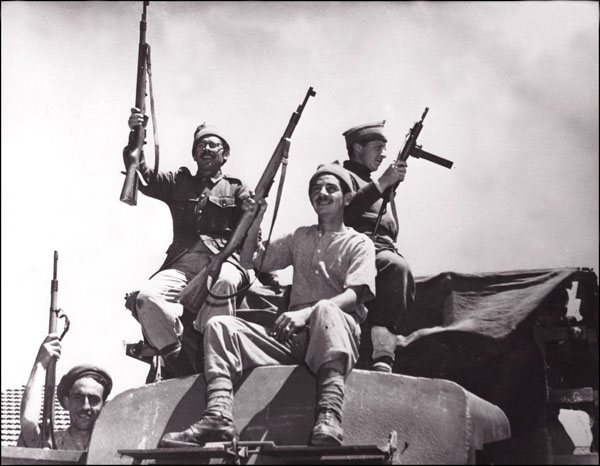
Lashing Back - Israel’s 1947-1948 Civil War

GUNS UP: Members of Haganah celebrate breaking the Arab forces’ blockade of Jerusalem, a success in April 1948 that helped to swiftly shift the momentum of the civil war toward Jewish forces. Photograph: AFP/Getty Images

From History.net:

Israel has fought and won three major wars in its 61-year existence. The best-known today are the Six-day War of 1967 and the 1973 Yom Kippur War. The first war it fought as a nation was in 1948, today referred to by Israelis as the “War of Independence” and by Palestinian Arabs as “al-Nakba,” the catastrophe. But perhaps the most important clashes in Israel’s relatively brief history took place in the months preceding its declaration of statehood on May 14, 1948, when the Haganah, the predecessor of the Israel Defense Forces—aided in a minor way by the dissident groups, the IZL and the LHI—battled Arab militias in the towns and villages of Palestine and along the roads linking them. At the time, Great Britain, while nominally charged with maintaining order as it disengaged from the Palestinian territory it had ruled since 1917, focused mainly on withdrawing with minimal casualties and with its political prestige in the Middle East intact, and only occasionally intervened in the fighting.

Read more
....

Tuesday, April 14, 2009

Ancient Chemical Warfare Discovered

The Roman Fort at Dura, Syria

From Live Science:

A fierce battle between Roman defenders and invading Persians took place at Dura, a garrison city on the Euphrates River in what is now Syria. That was around a.d. 256, nearly seventeen centuries before the 1925 Geneva Protocol outlawed the use of poison or asphyxiating gas in warfare. The ban might have altered the outcome at Dura had it been in force at the time.

Twenty Roman soldiers died quickly in a tunnel when the Persians forced in hot, sulfurous gas, says archaeologist Simon T. James of the University of Leicester in England. The Roman tunnel was intended to head off one that the Persians were digging to undermine a city wall. James points to sulfur crystals and pitch found in the Roman tunnel near its interception of the Persian one. When ignited, the substances produce an asphyxiating gas.

Read more ....

Sunday, April 12, 2009

Today's Pirates Hearken to 'Golden Age'

This map shows all the piracy and armed robbery incidents reported to the IMB Piracy Reporting Centre during 2009. Red shows attacks, yellow represents attempted attacks, and purple indicates suspicious vessels. Credit: Google/TerraMetrics/NASA/Data SIO/NOAA/U.S. Navy/NGA/GEBCO/Europa Technologies

From Live Science:

While Americans watch closely to see if Capt. Richard Phillips of the Maersk Alabama can be rescued from pirates off the coast of Africa in the Indian Ocean, maritime officials have tracked at least eight additional acts of piracy and armed robbery at sea in just the past 10 days.

The International Maritime Bureau has tracked these incidents off Somalia, in the Gulf of Aden, in the Arabian Sea and off Malaysia since April 1. Five of those incidents involved successful hijackings or robberies. In the other cases, ship masters were able to make evasive maneuvers or helicopters intimidated the pirates into aborting their attempts.

Read more ....

Tuesday, April 7, 2009

Sixty-Year Secret

James Wheeler, 90, talks to students Friday in Darrel Renfro's U.S. history class at Alamogordo High School. Wheeler survived a German bomb attack aboard a British transport ship and spent eight hours in 50-degree water in the Mediterranean Sea. He didn't talk about the incident for more than a half-century. (Michael Johnson/Daily News)

From Alamogordo News:

Ninety-year-old World War II veteran shares his experience as part of largest U.S. troop loss at sea.

James Wheeler kept a secret for nearly 60 years, but it wasn't the type of secret people keep to protect themselves from ridicule.

Far from it, in fact.

He was instructed by his superior officers in the U.S. Army to keep it. His parents never knew and he never told his wife of 35 years, Ruth Ann Wheeler, who died in 1992.

Wheeler, of High Rolls, will celebrate his 90th birthday today. He is a World War II veteran who was part of what many historians have called "the largest loss of United States troops at sea."

More than 1,000 U.S. troops died, yet not many Americans know about it. You won't find one word about it in history books. Alamogordo High School's two junior U.S. history classes, taught by Darrel Renfro, were fortunate to hear him finally talk about it Friday.

Read more ....

Monday, February 23, 2009

64 Years Ago Today-- Raising The Flag On Iwo Jima


From Gateway Pundit:

Raising The Flag On Iwo Jima.

This historic picture below was taken on Iwo Jima, February 23, 1945, by Joe Rosenthal. It depicts five United States Marines and a U.S. Navy corpsman raising the flag of the United States atop Mount Suribachi during the Battle of Iwo Jima in World War II.

(left to right) Ira Hayes, Mike Strank, Franklin Sousley, Rene Gagnon, John Bradley, Harlon Block.

In a day and age where the media and democratic politicians attack, ignore and slander the military, this photo is a good reminder of the many heroes who have served this great nation over the past 232 years.
Hat Tip Terry Harris

UPDATE: Navy Jag has a great Iwo Jima story here including video here and here.

Read more ....

My Comment: Thanks to Gateway Pundit for reminding everyone of this anniversary.