Showing posts with label future technology. Show all posts
Showing posts with label future technology. Show all posts
Friday, January 11, 2013

Wednesday, July 11, 2012
How New Scanners Will Revolutionize Security And Warfare

Cutting the queues: The laser scanners will be ten million faster than existing security scanning technology, which would presumably shorten lines at airports but also cause privacy issues
Homeland Security Buys 'Big Brother' Laser Scanner That Can Tell If You Are High, What You Are Carrying And Even What You Had For Breakfast... From 50 Meters Away -- Daily Mail
The latest scanners acquired by the U.S. government will be able detect the most minute traces of molecular discrepancies in both individuals' bloodstream and carry on luggage from 50 meters away.
Using advanced laser technology, Picosecond Programmable Laser scanners will show traces of drugs, chemicals, weapons, and even food you recently digested at the push of a button.
A non-governmental company originally developed the technology but has since partnered with the Department of Homeland Security, implying that the scanners will likely be deployed throughout airports and other high-risk areas.
Read more ....
My Comment: The security and military applications for this tech .... which is portable .... is astounding.
Wednesday, May 16, 2012
20 Innovative Defense Technologies

Military Transformers: 20 Innovative Defense Technologies -- Information Week
Department of Defense technologies under development, from brainy microchips to battlefield transformer vehicles, promise to make the U.S. military more nimble. Here's a visual tour of 20 breakthrough ideas.
Read more ....
My Comment: I have blogged on these new technologies before .... but it is nice to see it all bunched together in one post.
Friday, August 12, 2011
How Stick-On Circuit Technology Will Soon Be Worn By Our Soldiers
 How Computers Will Soon Get Under Our Skin -- Independent
A stick-on circuit can monitor heart rate as well as conventional devices, but is weightless, wireless and inconspicuous.
It may soon be possible to wear your computer or mobile phone under your sleeve, with the invention of an ultra-thin and flexible electronic circuit that can be stuck to the skin like a temporary tattoo.
The devices, which are almost invisible, can perform just as well as more conventional electronic machines but without the need for wires or bulky power supplies, scientists said.
Read more ....
My Comment: For more info on this technology and its military applications .... go here.
Monday, September 13, 2010
A Motorised Skateboard That Looks Like A Tank
Coming To A Battlefield Soon: The Incredible Motorised Skateboard That Looks Like A Tank -- The Daily Mail
It looks like the cross between a small tank, a Segway and a skateboard.
But this odd-looking contraption is being touted as the next must-have vehicle for U.S. soldiers in warzones.
The DTV Shredder can handle any kind of terrain at high speed and its low centre of gravity ‘makes it ideal for reconnaissance, rescue/recovery, mobile surveillance, and medical evacuation operations’, it is claimed.
Read more ....
My Comment: OK .... I am impressed. My nephew now wants to get his hands on one of them.
Wednesday, March 31, 2010
Tech That Uses The Ocean Waves To Power A "Vessel"
 Engage the wave drive (Image: Liquid Robotics)
Oceanology: Robot 'Gliders' Swim The Undersea World -- New Scientist
THE way we study oceans could be transformed by a high-tech "surfboard" that generates its own power from sunlight and water waves. The device is capable of navigating at sea for months at a time and recently completed a 4000-kilometre trip from Hawaii to San Diego, California.
Read more ....
My Comment: I am curious to know if (and how) this technology can be applied to larger vessels in the US Navy ... because it sounds cool to me.
Sunday, February 21, 2010
How Technology Will Defeat The Taliban
 Photo: Ever more sophisticated equipment is being tested at the Aberdeen proving ground in Maryland to counter the threat
Robots And Bees To Beat The Taliban -- Times Online
The homemade IED is the extremists’ deadliest weapon and America is spending billions on trying to combat it. We are granted access to this secret, smart and bizarre world.
The soldier breathes loud and fast as he lays a timed charge on an explosive in a Baghdad street. “I want these people to know if they’re going to leave a bomb on the side of the road for us, we’re just going to blow up their f****** road,” he growls, walking away. Before he can reach safety, an Iraqi punches a code into a mobile phone. The explosion sends the soldier flying in a cloud of dust and debris.
Read more ....
My Comment: Defense budgets are certainly targeting these areas for research and development .... expect even more "impressive" things as the years go by.
Sunday, December 6, 2009
Prison In Illinois To Be Chosen To House Guantanamo Inmates
 New Gitmo? The Thomson Correctional Center, in Illinois, could start to house detainees from Guantanamo Bay. Photo from The Daily Mail.
Illinois Prison Likely To House Detainees -- Washington Post
Despite GOP concerns, facility seen as choice to replace Guantanamo.
CHICAGO -- Despite opposition from congressional Republicans, the Obama administration is signaling that a state prison in rural Thomson, Ill., will probably become the new home for scores of terrorism suspects now housed at the U.S. naval base at Guantanamo Bay, Cuba.
Officials from the White House, Defense Department and U.S. Bureau of Prisons spent two hours last week briefing more than a dozen members of the Illinois congressional delegation in the office of Senate Majority Whip Richard J. Durbin (D-Ill.). To reassure skeptical Republicans, they emphasized security.
Read more ....
My Comment: Spending money like there was no tomorrow .... even though the facilities at Guantanamo were more than adequate to house these detainees. Image and politics .... it's all about image and politics.
Tuesday, August 25, 2009
A Portable Device For Frying Electronics
 Circuit Breaker: Microwaves cause a current surge that kills electronics.
Courtesy Texas Tech University
From Popular Science:
An enemy missile has no strategic value if its computer is down. A high-power-microwave emitter can disable a missile's electronics on the launchpad, leaving bystanders unharmed -- and now Texas Tech University engineers have a plan to scale down the truck-size tech.
To make strong microwaves, you need a lot of electricity, usually from a bulky generator. Instead the team packed small explosives into a five-foot-long, six-inch-wide tube. The detonation produces a burst of electrons, which power a microwave tube—similiar to the type in a microwave oven—that radiates microwaves.
Read more ....
Tuesday, April 7, 2009
The Future Of The Military -- Perhaps
 Recon Robot: The remote-control Small Unmanned Ground Vehicle
feeds images to soldiers in real time Brent Humphreys
From PopSci.:
The most ambitious weapons program in Army history calls for a whole new arsenal of connected gear, from helicopter drones to GPS-guided missiles. But what happens if the network that links it all isn’t ready?
The Army wants to modernize -- and Defense Secretary Robert Gates isn't sure he wants to pay. Among the budget cuts he announced yesterday was a major hit to the Army's most ambitious new weapons program, Future Combat Systems (FCS). Under Gates's proposed budget, a set of FCS fighting vehicles that was supposed to provided light-brigade speed with heavy-brigade punch will be axed entirely. And you know what? Maybe that's okay. The core of what makes FCS futuristic is its ambitious wireless network, which will connect soldiers, surveillance drones and sensors, giving everyone more and better information than ever before.
Author James Vlahos explains how it's all supposed to work in this article, from our May issue.
Read more ....
My Comment: An interesting and (a recommended article) to be read.
Tuesday, March 31, 2009
Homeland Security Seeks Bladerunner-Style Lie Detector
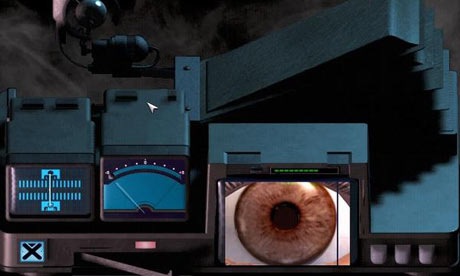 Bladerunner: The Voight-Kampff test. Photograph: Public Domain
From The Guardian:
Do our eyes betray us when we lie? The US government hopes to find out.
In Ridley Scott's 1982 sci-fi classic, Bladerunner, the police have a problem. The wayward androids they are pursuing behave so much like humans, they have a tough time telling them apart.
They turn to the Voight-Kampff test, a futuristic version of the age-old polygraph, to help them out. During the test, subjects are grilled with a list of questions, while their physiology is monitored. In particular, the test looks for abnormal eye responses that might indicate the subject isn't human.
Read more ....
Subscribe to:
Posts (Atom)