Showing posts with label future of war. Show all posts

Tuesday, July 26, 2011

Will Recent War Lessons Aid Future Military Programs And Institutions?

Photo: U.S. President Barack Obama meets with General Ray Odierno after stepping off Air Force One at Baghdad International Airport in Baghdad, April 7, 2009. (Reuters)

Odierno: Recent War Lessons Will Aid Future -- Washington Post

Gen. Ray Odierno, the soon-to-be Army chief of staff, described last week how he hoped to reshape his service as officers like himself, battle-tested over the last 10 years, return from Iraq and Afghanistan.

“We have majors today and captains today that all they’ve experienced is war,” Odierno said during his confirmation hearing before the Senate Armed Services Committee. Change, he added, “is about challenging these leaders who have had so many challenges and been so successful. . . . We have to be able to continue to challenge them because we’re going to need them as we move forward in the future.”

Read more ....

My Comment: Changing the culture in any military organization is very hard to do, they operate as huge bureaucratic institutions in which change is something that is very hard to accept and even more difficult to implement. I wish General Odierno success in changing this culture .... but if history is any indication .... it is going to be very difficult and the odds are against him.

Thursday, June 16, 2011

How Google Earth, iPhone Apps, And Playing 'Call Of Duty" Can Be Used In A War Zone

A screenshot from the game Call of Duty. Inset: the iPhone compass app, and a Google Earth image of Misrata, Libya. Source: Supplied

Google Earth, An iPhone Compass And Experience Playing 'Call of Duty' Have Been Vital To Libya's Rebel War Plan -- The Australian

IT is probably not what the designers of Google Earth had in mind, but for the rebels in the besieged Libyan city of Misrata their software has become a crucial part of the revolutionary armoury: a free battlefield system that helps them to aim mortars and pinpoint Gaddafi tanks.

Other uprisings in the Arab Spring have leant heavily on the organising powers of Facebook and Twitter, but in Libya it is Google Earth that has become an invaluable asset.

Read more
....

Update: Libyan opposition turn to Google Earth, Call of Duty in battle against Gaddafi forces -- News.com.au

My Comment:
The meek (and geeks) are not only going to inherit the earth .... but also its battlefields.

Thursday, June 2, 2011

One Day Soldiers May Be Flying Around In Their Own Jetpack


Video: Martin Jetpack Crushes Previous Record by Climbing to 5,000 Feet -- Popular Science

The folks at Martin Jetpack wanted to test their ballistic parachute, but there was a problem--their previous tests had only taken their prototype “jet pack” up to very low altitudes, heights too low to deploy their safety ‘chute. No guts, no glory, as it is said. The video below captures the Martin Jetpack climbing to 5,000 feet in a 10-minute flight (both records for the aircraft as far as we know).

Read more ....

My Comment
: I do not know if soldiers in the future will be flying around in these jetpacks .... but they would certainly look cool if they do.

Tuesday, May 31, 2011

The New Age Of Warfare Will Use Mini-Weapons

Raytheon is developing a 13-pound GPS-guided "smart bomb" intended to be dropped from a drone. (Jim Muntz/Raytheon Co. / May 31, 2011)

Pentagon Seeks Mini-Weapons For New Age Of Warfare -- L.A. Times

In an effort to cut costs and avoid civilian casualties, manufacturers are developing small 'smart bombs,' drones that resemble model planes and microscopic crystals to tag enemy targets.

Under mounting pressure to keep its massive budget in check, the Pentagon is looking to cheaper, smaller weapons to wage war in the 21st century.

A new generation of weaponry is being readied in clandestine laboratories across the nation that puts a priority on pintsized technology that would be more precise in warfare and less likely to cause civilian casualties. Increasingly, the Pentagon is being forced to discard expensive, hulking, Cold War-era armaments that exact a heavy toll on property and human lives.

Read more ....

My Comment
: Warfare is rapidly becoming a conflict of economics .... the use of expensive jet planes and pricey bombs do not make sense in today's conflicts .... especially when a low cost drone with a small missile can do the same job.

Sunday, May 8, 2011

Drones And Special-Ops Is The Future Of The Military

Special-ops Units And Drones May Increase In Future Military -- Sign On San Diego

It was a band of 25 brothers, Navy SEALs, who took down Osama bin Laden last week — not a Marine battalion or an Army division.

As the United States gradually moves away from its major wars in Iraq and Afghanistan, what will its future military force look like — more like that SEAL squad working in secret and in tandem with the Central Intelligence Agency?

Read more ....

My Comment: The key paragraph is the following ....

.... Since 2001, the military’s Special Operations Command has seen its budget more than quadruple — from about $2.3 billion in 2001 to $9.8 billion today. Its ranks have expanded from 45,500 a decade ago to 61,500 today, according to The Associated Press, citing Pentagon figures.

The numbers say it all.

Monday, April 25, 2011

Are We Approaching A Technological Tipping Point In Warfare?

A Reaper takes off from Creech Air Force Base.

Are Drones A Technological Tipping Point In Warfare? -- Washington Post

Debates are growing at home and abroad over the increasing use of remotely piloted, armed drones, with a new study by the British Defense Ministry questioning whether advances in their capabilities will lead future decision-makers to “resort to war as a policy option far sooner than previously.”

Active and retired U.S. Air Force officers involved in developing drones stress that the aircraft brings in more decision-makers, better targeting data and more accurate delivery systems than fighter jets.

Read more ....

My Comment:
My must read article for today. There is very little that I disagree with in this post, and it sums neatly the direction that policy makers are now finding themselves as drones and other robotic military tools are becoming more accurate and sophisticated.

Monday, January 17, 2011

The Dangers Of Information Overload On The Battlefield

At Langley Air Force Base in Virginia, teams monitor what they have nicknamed “Death TV” — live video from Afghanistan. Doug Mills/The New York Times

In New Military, Data Overload Can Be Deadly -- New York Times

When military investigators looked into an attack by American helicopters last February that left 23 Afghan civilians dead, they found that the operator of a Predator drone had failed to pass along crucial information about the makeup of a gathering crowd of villagers.

But Air Force and Army officials now say there was also an underlying cause for that mistake: information overload.

At an Air Force base in Nevada, the drone operator and his team struggled to work out what was happening in the village, where a convoy was forming. They had to monitor the drone’s video feeds while participating in dozens of instant-message and radio exchanges with intelligence analysts and troops on the ground.

Read more ....

My Comment: I must confess that over the years of editing this blog .... I have been overwhelmed with information .... and this blog is nothing when compared to the information that drone operators must filter through when they are looking at multiple targets from Afghanistan or from any other war zone.

My prediction .... information overload is going to be a growing problem as technology improves in obtaining data from a battlefield .... and there is very little that can be done about it.

Saturday, January 8, 2011

How Israeli Technology Is Speeding Up Warfare


New Israeli Military Technology Speeds Up Warfare -- Ynet News/AP

Sophisticated communication system that compiles battlefield information in video game-like map interface designed to knock down military's response time.

Intense winds scraped sand from the desert floor, clouding the view and leaving the Israeli soldiers scarcely able to see each other as they practiced blasting artillery shells at distant targets.

In a nearby armored vehicle, commanders armed with small screens could easily monitor every cannon, jeep and target involved, ordering strikes with the tap of a finger. Their weapon: a sophisticated communication system that compiles battlefield information in an easy-to-use, video game-like map interface, helping militaries make sense of the chaos of battle.

Read more ....

My Comment: Sharing information quickly .... and acting on it even more quickly .... that is one trend that many military organizations (Israel included) are quickly developing.

Tuesday, November 23, 2010

Robots Will Be The Future Of War

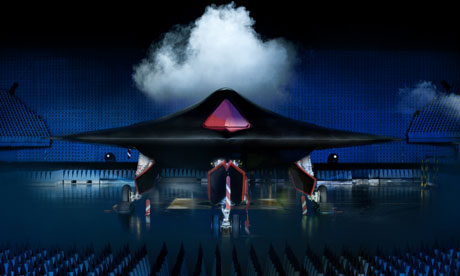
BAE Systems unveils its Taranis unmanned stealth aircraft prototype. Photograph: BAE Systems

Rise Of The Robots And The Future Of War -- The Guardian

With the RAF and the Pentagon pouring huge sums into robotics, Jon Cartwright asks how this could change warfare and what ethical and legal challenges will follow.

Faced with an enemy fighter jet, there's one sensible thing a military drone should do: split. But in December 2002, caught in the crosshairs of an Iraqi MiG, an unmanned US Predator was instructed to stay put. The MiG fired, the Predator fired back and the result, unhappily for the US, was a heap of drone parts on the southern Iraqi desert.

This incident is often regarded as the first dogfight between a drone, properly known as an unmanned aerial vehicle or UAV, and a conventional, manned fighter. Yet in a way, the Predator hardly stood a chance. American and British UAVs are operated remotely by pilots sitting thousands of miles away on US turf, so manoeuvres are hobbled by signal delays of a quarter-second or more. This means evading missiles will always be nigh-on impossible – unless the UAVs pilot themselves.

Read more ....

Update: Future of war rests with robot Rambos -- ABC News (Australia)

My Comment: UAVs in the air, army bots on the ground, and now the U.S. Navy has its own program .... yup .... the future (appears) to be in robotic platforms.

Wednesday, October 27, 2010

Drone Video Feeds To Troop Cell Phones in 2 Years

U.S. soldiers use their mobile phones to record a television broadcast showing the inauguration of Barack Obama as the 44th President of the United States, at a U.S. base in Kabul, January 20, 2009. Credit: Reuters/Ahmad Masood

U.S. Army Sees Video To Troop Cell Phones In 2 Years -- Reuters

(Reuters) - The U.S. Army could be streaming surveillance video images from unmanned planes to solders' cellphones in about two years, a senior Army official said on Tuesday.

The Army remains committed to the Joint Tactical Radio System (JTRS) as the main means for disseminating video images to the battlefield, a big program that is still under development and should be fielded in 2014, said Tim Owings, deputy program manager for Army unmanned aerial systems.

Read more ....

Update: US Army to bring drone images to troop phones soon -- Electronista

My Comment: Once this app is in the field, you just know that soldiers on the ground will be "screaming" to have drones over their heads when they go out on patrol.

Saturday, October 23, 2010

What Are Military R&D Departments Developing For Tomorrow's Soldiers


WTF Weapons, From Spy Saucers To Flying Lightsabers -- The Danger Room

Adm. Gary Roughead, the Navy's top officer, is all about practicality these days. In a document he issued to his sailors earlier this week, he vowed that when it came to military gadgets, the Navy would "only develop those capabilities we need, not just want." In these tough economic times, Roughead speaks for a lot of the military's top brass.

Except when he doesn't. R&D in the American military -- and other militaries, ally and enemy alike -- is a story of madcap engineering, oddball design, and loose definitions of "need" and "want." Think rocket launchers that shoot nukes, flying saucers and laser-blasting jets. Definitely laser-blasting jets.

Read more ....

My Comment: What do I see .... robots .... lots of robots.

Sunday, August 29, 2010

Trade Shows What The Future Of Warfare Will Be

AeroVironment's nano-UAVs include one that looks and flies like a real hummingbird and could be used for spying in buildings. The drone is still in the research stage. Sharon Weinberger for AOL News

At Robot Show, Future Of Warfare Is On Display -- AOL News

DENVER (Aug. 27) -- From robotic insects that can crawl and fly to spy drones that look and move like real hummingbirds, the future of warfare was on display this week at a massive robotic conference here.

This year's Association of Unmanned Vehicle Systems International show attracted more than 6,000 visitors --- well above what organizers expected. But perhaps more striking than the number of visitors was the diversity of military and civilian robots and drones on display.

Read more ....

My Comment:
What was once only in Hollywood movies, the use of robots and unmanned vehicles in war zones is rapidly becoming the fastest growth industry for military developers and contractors.

My gut (though) tells me that what we are witnessing today, is nothing when compared to what we will exposed to in 20 - 30 years time.

Tuesday, May 18, 2010

The Next BIG War Will Be In Asia

Would-Be Asian Superpowers Prepare To Clash When USA Weakens -- Pravda

India will begin the development of its own anti-missile defense system in 2010, the first elements of which, according to reports in Indian newspaper The Hindu, will appear in 2012. The system will be completed by 2016. This information was announced by the Head of the Defense Research and Development Organization (DRDO) in India.

The anti-missile defense system is intended to fulfill various functions, including the attack of targets at a height of over 50 km (in the stratosphere). The anti-missiles PAD and AAD have been designated to carry out this function.

Read more ....

My Comment: The Pravda commentator uses India's anti-missile program as a backdrop to the growing militarization of Asia and the tensions that it produces. But is his assertion that war in the region will become more likely as this militarization continues and U.S. power wades in the region .... hmmmm .... I would have to say yes.

The 21rst century will be Asia's. More than half of the world lives in this region, and the regional economic and political trends are all on the upswing. This increase in political/economic/and military clout has resulted in tensions and old age animosities coming to the forefront .... a fact that we can now see between India and China and their long existing territorial disputes.

As competition for economic resources and political alliances increases .... with no third party mediation .... anything will then become possible. In Asia's case .... if history is any indication .... this competition has always resulted in large scale regional wars.

Friday, April 9, 2010

What Are The New Rules Of War


The New Rules of War -- Foreign Policy

The visionary who first saw the age of "netwar" coming warns that the U.S. military is getting it wrong all over again. Here's his plan to make conflict cheaper, smaller, and smarter.

Every day, the U.S. military spends $1.75 billion, much of it on big ships, big guns, and big battalions that are not only not needed to win the wars of the present, but are sure to be the wrong approach to waging the wars of the future.

Read more ....

My Comment: If you have nothing to do .... the above video is a must see for those who are studying and trying to understand the future of war. Both John Arquilla and Victor Davis Hansonare are involved in the discussion .... and they alone makes this video a must see.

Monday, March 22, 2010

Are Force Fields For The Military The Wave Of The Future?

Star Trek-Style Force-Field Armour Being Developed By Military Scientists -- the Telegraph

A space-age "force field" capable of protecting armoured vehicles and tanks by repelling incoming fire is being developed by British military scientists.

The new type of armour will use pulses of electrical energy to repel rockets, shrapnel and other ammunition that might damage a vehicle.

Researchers at the Defence Science and Technology Laboratory (Dstl), which is the research and development arm of the Ministry of Defence, claim it is possible to incorporate material known as supercapacitors into armour of a vehicle to turn it into a kind of giant battery.

Read more ....

My Comment: These researchers sound very optimistic .... but I am not. When they have a working prototype on the battlefield is when I will start to believe in this technology .... but for the moment I will continue to enjoy my science fiction knowing that it is science fiction.

Wednesday, February 3, 2010

Future Soldiers May Get Brain Boosters And Digital Buddies

Caption: The Future Soldier Initiative. Credit: U.S. Army Natick Soldier Research Design and Engineering Center in Massachusetts.

From Live Science:

The soldiers of the future might controversially boost their brains with drugs and prosthetics, augment their strength with mechanical exoskeletons, and have artificially intelligent "digital buddies" at their beck and call, according to the U.S. Army's Future Soldier Initiative.

The project is the latest attempt from the U.S. Army research lab in Natick, Mass., to brainstorm what soldiers might carry into the battlefield of tomorrow. A special emphasis of its concept is augmenting mental performance.

Read more ....

My Comment: An interesting look at what "super soldiers" may look like in the future.

Saturday, January 23, 2010

Powerful Exoskeletons For Future Soldiers


Super-Soldier Exoskeleton To Get 3-Day Fuel Cell Powerpack -- Register

Mech-troopers will be able to plug in gadgetry, too.

A radical powered exoskeleton under development for use by the US military is to be fitted with fuel-cell power supplies which will increase its endurance from hours to days - and furnish juice for the burgeoning load of electronics carried by modern soldiers, too.

Global arms behemoth Lockheed, developing the Human Universal Load Carrier (HULC™) after buying the originating firm Berkely Bionics, announced this week that fuel-cell firm Protonex will "develop power supply concepts that will enable the HULC™ robotic exoskeleton to support 72+-hour extended missions". Here's a company promo vid about the HULC:

Read more ....

My Comment: This is incredible stuff.

Thursday, September 17, 2009

Generals Look To Future Challenges, Opportunities

Air Force Chief of Staff Gen. Norton Schwartz joined 13 other generals during a panel discussion Sept. 16 at the 2009 Air Force Association Air & Space Conference and Technology Exposition held at the National Harbor in Oxon Hill, Md. (U.S. Air Force photo/Scott M. Ash)

From TheU.S. Air Force:

9/16/2009 - WASHINGTON (AFNS) -- Air Force Chief of Staff Gen. Norton Schwartz joined 13 other generals during a panel discussion Sept. 16 at the 2009 Air Force Association Air & Space Conference and Technology Exposition held at the National Harbor in Oxon Hill, Md.

"This is the group of leaders that strives every day to be worthy of the brilliance and excellence of our Airmen," General Schwartz said in kicking off the forum.

Each general offered an opening remark addressing their two main challenges on the five-to-ten year horizon, answered questions from audience members, and closed the forum by addressing the theoretical question, "If you had one more dollar to spend, what would you do with it?"

Read more ....

My Comment: Aside from the meeting itself .... there is nothing special to report.

Wednesday, April 15, 2009

Limited Armed Stabilization And The Future Of US Landpower

U.S. Army soldiers prepare to load a UH-60 Black Hawk helicopter for transportation to an area south of Balad Ruz, Iraq, March 22, 2009. The soldiers are assigned to the 25th Infantry Division's 1st Battalion, 24th Infantry Regiment, 1st Stryker Brigade Combat Team.
U.S. Navy photo by Petty Officer 2nd Class Walter J. Pels

From Defense Talk:

The author takes a critical look at the mission assignment and orientation of U.S. landpower. He calls for an unconventional revolution in U.S. land forces that optimizes them for intervention in complex and violent crises of governance and security in states crippled by internal disorder. In the end, he argues that the armed stabilization of states and regions in crises will be not just equivalent in importance to traditional warfighting in future land force planning but instead the primary land force mission for the foreseeable future.

Read more ....