Showing posts with label commentary -- nuclear strategy. Show all posts

Wednesday, March 13, 2013

Can A U.S. Nuclear Force Of Only 300 Strategic Weapons Be Enough To Deter A Nuclear Attack On America?

Photo: United States Trident II (D-5) missile underwater launch. Wikipedia


Time To Change America’s Atomic Arsenal -- Tom Nichols, The Diplomat

The new mission for U.S. nuclear weapons -- minimum deterrence: The prevention of a major nuclear attack on America with a small force -- perhaps as low as 300 strategic weapons.

Nuclear weapons in 2013 have been pushed yet again into the policy background as more pressing matters – the appalling collapse of the U.S. budget process among them – have absorbed all of Washington’s intellectual bandwidth. President Obama’s reelection means that the United States will remain publicly committed to nuclear reductions, but the studies that were supposed to detail those further reductions are now languishing in bureaucratic limbo and are unlikely to be a high priority. If nothing changes, the U.S. strategic deterrent will stay right where it has been since the early 1990s: merely a smaller version of the force we once arrayed against the Soviet Union.

Read more ....

My Comment:
He makes a convincing argument .... that the use of nuclear weapons is what deterred both countries (the U.S. and the Soviet Union) from using nuclear weapons .... not the quantity of weapons that are available. But the Russians are not biting .... and for minimum deterrence to work it is preferable that both countries are on-board.

Monday, July 9, 2012

Should the U.S. De-Alert It's Land-Based Nuclear Missiles?


13 Minutes To Doomsday -- Washington Post editorial

THROUGHOUT THE Cold War, the United States kept land-based missiles with nuclear warheads on alert and ready to launch in three to four minutes after the president gave the order. Every president of the missile age was briefed about the procedure: In the event of an impending attack, the decision to launch would have to be made in 13 minutes or less. The theory of deterrence was that the United States had to threaten certain and large-scale retaliation against the Soviet Union, and that meant being prepared to shoot fast.

Read more ....

My Comment: I can see the logic in 'de-alerting' our land based nuclear missiles. It lessens the chance of an accidental launch, and we will still have our submarine nuclear deterrent intact. Will Russian President Putin see this the same way .... from what I am reading in the Russian press, I will have to say no .... especially since the issue of missile defense has not been resolved.

Thursday, September 15, 2011

Would President Obama Retaliate Against A Nuclear Attack?


Would Obama Retaliate Against A Nuclear Attack? -- Rabbi Aryeh Spero, American Thinker

What if a Muslim country, such as Iran, launched a nuclear attack against us, or if agents aligned with Pakistan using dirty bombs were to attack America? Would Barack Hussein Obama retaliate with nuclear force, as has been our stated policy since the 1950s? Would he even unleash a barrage of non-nuclear shock and awe that would level those countries so that they'd be incapable of striking a second time?

Read more ....

My Comment: If the US was to suffer a nuclear attack .... and the attacker is known .... the sequence of events that will occur will propel President Obama to respond .... and respond forcefully even if he is inclined not to. Reason ..... failure to do so will result in such an outcry that he, his policies, and the Democrat party will be consigned forever to the dustbin of history .... something that would be totally unacceptable to him and to most of his loyal backers.

Monday, August 9, 2010

A Must Read Commentary On Nuclear Deterrence In the 21rst Century


The Nukes We Need: Preserving the American Deterrent -- Keir A. Lieber and Daryl G. Press, Foreign Affairs

Summary:

The Obama administration is right that the United States can safely cut some of its nuclear arsenal, but it must retain the right capabilities. Otherwise, the United States' adversaries might conclude -- perhaps correctly -- that Washington's nuclear strategy rests largely on a bluff.

KEIR A. LIEBER is Associate Professor in the Security Studies Program at Georgetown University's Edmund A. Walsh School of Foreign Service. DARYL G. PRESS is Associate Professor of Government at Dartmouth College and Coordinator of the War and Peace Studies Program at the John Sloan Dickey Center for International Understanding.

Read more ....

Hat Tip: Theo Spark

My Comment: For the rest of the article (because of membership restrictions), go to the link here.

Monday, February 9, 2009

Committing To Cut

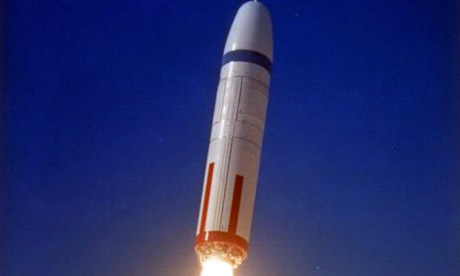
A Trident missile at liftoff. Photograph: AP (Image from The Guardian)

Cutting the Stockpile -- In From The Cold

Say this for Hillary Clinton: she knows how to follow her marching orders.

Apparently, all those years with Bill were excellent preparation for carrying out ill-advised or foolhardy tasks. From that ill-fated national health care plan to ignoring her husband's many indiscretions, Ms. Clinton is adept at handling chores that most of us would summarily reject.

Consider her newest priority as Secretary of State. Ms. Clinton has informed Congress (and her staff) that she wants early talks with Russia on "sharply reducing" the size of both nation's nuclear arsenals. The goal is a replacement for the 1991 Strategic Arms Reduction Treaty, which limits the U.S. and Russia to 6,000 nuclear warheads each.

Some wonder if a new accord is even necessary--but both countries are far below that total. The U.S. stockpile is believed to be at 2,300 warheads, and the Russian inventory is even lower. But Secretary Clinton and President Barack Obama are aiming for even greater reductions. How low are they willing to go? The Administration hasn't said--at least publicly. But, as with other Obama proposals, there are grave risks that may outweigh potential benefits.

Read more ....

My Comment: Another must read post and commentary from "In From The Cold".

The reason why they are doing this is .... for the politics. Nothing more. And the Clintons are grandmasters at politics.

The greater concern is that military and defense policy .... including the future of America's strategic nuclear weapon's program .... is now out of the hands of the military and in the hands of political operatives and their masters. I can only assume that Leon Panetta's nomination to the Director's chair of the CIA is being done to produce the same result and intent.

This is troublesome to the extreme.

U.S. Security and Defense policies functioned best when it was treated as a joint venture. Both sides bringing their expertise and understanding to the table.

Sigh .... no more now.